Told from Above · a Shramko 360 series
 Author: Andrii Shramko
Lock IV and Okole, Bydgoszcz — a guided 360° flight
- 8 min
- 360° · 8K
- Open captions
- Online since 6 October 2026
Why was Okole called Schleusenau in German?
About the film
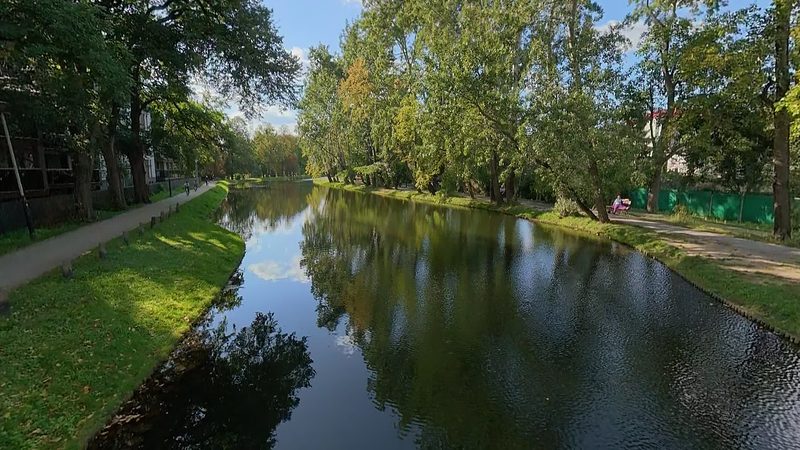
Because "Schleuse" is German for a canal lock. Okole came into being when a canal built in 1774 cut off the northern part of the Wilczak Wielki estate. In this film I fly over Lock IV Wrocławska with its wooden gates and along the old Bydgoszcz Canal.
The guide tells where military bands played on Sundays, where people from town went to eat in the garden restaurants by the locks, and who really planted the poplars known as Wilhelm's poplars. The promenade on the south bank is named after the actor Leonard Pietraszak, who as a boy came to this canal and went to the secondary school next to it.
Most visitors to Bydgoszcz stay in the Old Town. Make time for a walk along the old canal too, from one lock to the next.
Places in the film
- Lock IV Wrocławska (Śluza IV) Map
- Bydgoszcz Canal (Kanał Bydgoski) Map
- Okole Map
- Canal park (Planty nad Kanałem Bydgoskim) Map
The guide's full text (English)
Franz von Brenkenhoff, the Prussian governor, inspected this spot himself and talked King Frederick II into approving the canal of Śluza IV Wrocławska, the lock with wooden gates below us.
Okole was born when this canal cut an estate apart. Built in 1774, it severed the northern part of the Wilczak Wielki estate, and over time that cut-off piece became a separate place, called Schleusenau in German.
Why that German name? Schleuse is German for lock, and the far bank lived so closely with this canal that its name comes out, in a free Polish translation, as Śluzowo: Lockville.
The Polish name has a legend, printed by Wincenty Sławiński in 1935. A German minting poor coins for the king refused a holy image on them, fought, and fled west across country, by a road later called the okólna.
At the eastern end of the district, the canal was simply filled in. Nearly a kilometre vanished with its locks and a bridge, and a wide road took its place, first Armii Czerwonej, for the Red Army, now Focha.
The Petersons, who owned Okole across the water, and Leonard Pietraszak, the Bydgoszcz actor who grew up beside this canal, each have a story waiting for us further along.
The town once came out here to eat. Back at Śluza IV Wrocławska, its gates closing this reach: the most popular restaurants on the old canal stood by the fourth and fifth locks, Kleinert's garden and Kruger's among them.
Okole was in the hands of a single family. In 1818 the building councillor Ernst Conrad Peterson took both its estates on hereditary lease, a brickworks among the buildings, and the Petersons remained the owners of Okole until 1945.
Ernst Conrad Peterson also did charity work: in 1817, at his own expense, he built both a school and an orphanage in Czyżkówko, and paid the teachers and carers there.
The trees people call Wilhelm's poplars were planted by someone else: in Napoleon's day, General Wincenty Aksamitowski, one of the Emperor's adjutants, set out these rows along the canal, and today they are natural monuments.
On Sundays this canal had music. Military bands played by the fifth and sixth locks, Idzi Świtała founded a leisure complex in this park in 1928, and gentlemen rowed ladies along the water.
When the Marshal came, he wanted the canal first. In 1921 Józef Piłsudski began the private part of his tour of Bydgoszcz right here, with this canal and its park.
The south bank has a thirsty legend. A tenant of the Wilczak manor, the story goes, greeted his guests Wilkiem, with the wolf: a big goblet, once called a wilk, full of fiery drink.
The far bank once counted its languages. The official census of 1910 found 6858 people in Okole, and most of them spoke German, while Polish speakers were a small minority and a few dozen gave Hebrew.
A son of the far bank died with a different name. He was born there as Johannes Franz Piotrowski, and he died as Hanns Anselm Perten, an actor, director and theatre manager in East Germany.
Why the new name? His bride's father disliked the Polish-sounding Piotrowski, so on home leave Perten asked his own father, who in 1940 changed both their names, borrowing Perten from the lettering on Pertenreiter furniture vans.
Prussia kept Okole waiting. Its authorities tried again and again, in 1893 and as late as 1919, to bring Okole into the city, and each time put it off, partly fearing the Poles in the suburbs.
Polish Okole had no Catholic church. It joined Bydgoszcz in April 1920 and Poles became the clear majority, yet between the wars there was only a chapel of the Elizabethan Sisters on Staroszkolna Street.
Why does this south-bank walk carry the name of Leonard Pietraszak, a Bydgoszcz actor, when beyond the trees runs Nakielska Street, the old road west to Nakło on the Noteć?
As a boy, Leonard Pietraszak walked this canal and went to the Third Lyceum next door, so it was at a party called Vabank by the Canal that the walk was given his name.
As a boy, Leonard wanted to follow his brother, who boxed in the United States. He began training under coach Rinke, but the adventure was short: after he lost a fight in Solec Kujawski, his father banned him from boxing.
Who built the school across the water? The plans of III LO w Bydgoszczy were approved by building councillor Johannes Schwarze, and its main builder was Bruno Wiese, a Bydgoszcz master carpenter.
The Petersons saw the railway boom coming. They sold their plots for the Eastern Railway from Berlin to Königsberg, for lines to Inowrocław and Poznań and a narrow-gauge line to Koronowo, and grew very rich.
This school began with a German name. III LO w Bydgoszczy, the Third Lyceum, the red-brick building behind the football pitch, was founded in 1879 as the commune school of Okole, Gemeindeschule Schleusenau, when Okole was still a suburban commune.
Back then the building was shared by neighbours who did not get along. In the 1920s its Polish pupils shared it with a German Protestant school, until the German school moved to another building in 1933.
Okole finally got its Catholic parish. Kościół św. Wojciecha, Saint Adalbert's, the pale clock tower under a red roof, became a parish under Cardinal August Hlond in October 1946 and was refitted for Catholic worship.
So the suburb named for a lock keeps both its names.
How the film was made
8K (7680×3840), 60 fps. Open captions in English, burned into the picture: three copies around the view, one next to the place being described. Narration: a synthetic voice in English.
The guide's facts come from:
Back to all filmsFor the cityFilms for deaf and hard-of-hearing viewers
Andrii Shramko
Engineer and filmmaker, living in Bydgoszcz. I have been filming 360° in motion since 2015.