Told from Above · a Shramko 360 series
 Author: Andrii Shramko
Lock VI and the Old Canal at Flisy, Bydgoszcz — a guided 360° flight
- 12 min
- 360° · 8K
- Open captions
- Online since 5 November 2026
By the Okole lock in Bydgoszcz stands a tank turret: an episode of "Four Tank-Men and a Dog" (Czterej pancerni i pies) was filmed here.
About the film
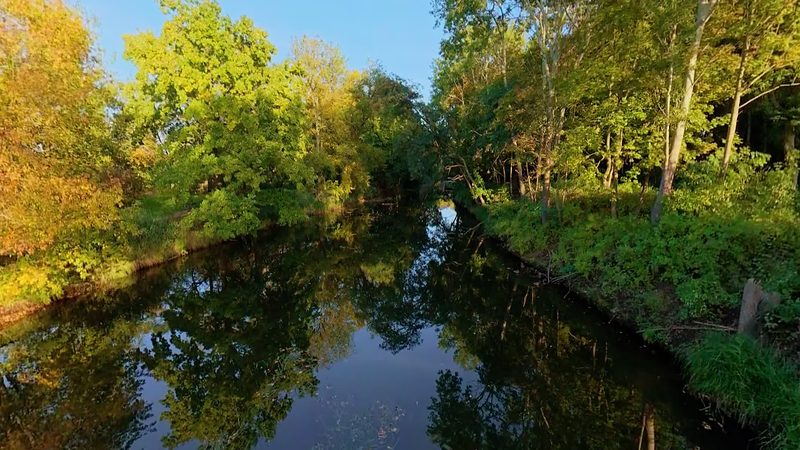
In this film I fly low over the Old Bydgoszcz Canal, from Lock VI on Bronikowskiego Street through Flisy to the railway bridge of the Coal Trunk Line, and at the end I rise above the treetops.
The guide tells the history of the area: the water tram and the ship Ondyna, the house with the goddess Fortuna on Nakielska Street, the bridge between Flisy and Miedzyń blown up in 1939, and the Coal Trunk Line, from the armoured train Śmiały to the ceremonial opening of its last section. One more story from the film: Leonard Pietraszak, a Bydgoszcz native remembered as Gustaw Kramer in "Vabank", gave his home town dozens of paintings by Jan Stanisławski and his students.
If you are ever in Bydgoszcz, walk along the Old Canal in Flisy: brick abutments are all that remains of the old bridge to Miedzyń.
Places in the film
The guide's full text (English)
Śluza VI Bronikowskiego, the brick lock right below us, has had a crossing since the late eighteenth century; in 1961 builders from Płock replaced its old timber footbridge deck with a concrete road bridge on the same abutments.
After the war engineer Stanisław Tychoniewicz designed a southern bypass canal from Osowa Góra to Łęgnowo, but money was short, nothing went beyond discussion, and the old waterway was simply kept in working order.
In June 2023 the old gates of Śluza VI Bronikowskiego, the brick lock behind the bridge, were taken out and replaced with new ones; the city looks after the Stary Kanał Bydgoski and its locks as a listed monument.
In 2006, a year after local enthusiasts formed a canal society, a memorandum was signed aboard the boat Władysław Łokietek, starting the effort to make the land along the canal and the water junction a protected cultural park.
Between the wars the Polish Red Cross, owner of the folwark estate here since 1921, split what was left into plots in 1927; homes rose on its old yard, and the lane called Jary became Red Cross Street.
Prussian maps called this road Nakelerstraße, and outside the town simply the Chaussee nach Nakel; between the wars it was Nakielska, and under the German occupation it carried the name of General Ludendorff.
An illegal fireworks workshop once ran in a flat on Nakielska; on an October afternoon thousands of bangers went off at once through carelessness, 3 people were killed, and the damaged house had to be pulled down.
The house at Nakielska 25 still has its richly decorated front and old double wooden doors, and from a niche at first-floor level a statue of Fortuna, the Roman goddess of luck, holds out her horn of plenty.
In 1956 the city sports office, OSiR, opened its biggest bathing place here, with open pools, paddling pools for children, a solarium and snack bars; by the 1980s it was abandoned, and the pools fell silent.
Marina Gwiazda nearby was the first harbour here built from scratch to a European standard; it was opened during the Ster boat fair by deputy infrastructure minister Anna Wypych-Namiotko and the city's president.
Since 2004 Bydgoszcz has run a water tram up and down the Brda and along the canal; some of its routes climb through the Miejska and Okole locks, and a ticket costs the same as an ordinary bus fare.
For a few summers a water-tram line called Szlakiem Śluz, the Lock Trail, ran from the marina twice a day through three locks into the city centre, until repairs to the locks stopped it in 2015.
The water tram's veteran boat, MS Bydgoszcz, began life before the First World War at the Gebruder Wiemann shipyard in Brandenburg as the Prinz Heinrich; early in the Second World War a Danzig shipowner, Franz Preukschat, bought her.
She sank in the Vistula Lagoon near the end of the war; salvage crews raised her, she was rebuilt at the former Wojan Werft yard in Gdańsk, and she came back under a new name, Gniew.
To help the old MS Bydgoszcz, the city later bought a pair of solar-powered boats from the German firm Yacht Concept Solartechnology and gave them a fitting name for boats that run on sunshine: Słonecznik and Słonecznik II, the sunflower.
The railway crossing this canal further on belongs to the interwar Coal Trunk Line, built to link Upper Silesia with the port of Gdynia bypassing the Free City of Danzig; it even passed Łódź by, several dozen kilometres away.
For many seasons the excursion ship Ondyna, built at the Gdańsk river shipyard, sailed to Brdyujście, along the Vistula and on this canal; she was named after a Lithuanian goddess of rivers and lakes.
On the Ondyna's upper deck people danced while the lower deck served food; schools and factories hired her for trips to Toruń and Chełmno, and when the Vistula ran too shallow she was sent along the canal to Nakło.
Among the city's big mills were those of Conrad Peterson at Okole, driven by water from the Flis stream, and Kentzer's mills on the Brda; around the turn of the century they switched from water power to electricity.
Sebastian Klonowic's poem about rafting down the Vistula is often read as the first guidebook to that river, and according to legend he set a magical place in the great bend below Bydgoszcz, the Piekielne Wrota or Hell's Gate.
Leonard Pietraszak, born in Bydgoszcz, played Gustaw Kramer, one of the main heroes of Vabank, a film whose story takes place in the 1930s, and nobody needs reminding who Kramer was.
In 2021 Leonard Pietraszak and his wife Wanda gave their home city several dozen paintings by the outstanding master Jan Stanisławski and by his pupils, to stay in Bydgoszcz for good.
Leonard Pietraszak's last wish was to rest beside his beloved mother, and so his ashes were laid in the Starofarny cemetery, the old parish burial ground of Bydgoszcz, close to the green banks of this canal.
On the far bank lies Wilczak, where by the end of the nineteenth century the Blumwe machine works had agents in Berlin, Magdeburg and Cologne and sold its products as far as China, America and Africa.
President Ignacy Mościcki signed the decree to build the coal line's stretch from Herby to Inowrocław only in February 1928, though by then much of its earthwork had already been finished.
On the coal line in February 1979, an ST44 locomotive was pushing a snowplough when the train hit a snowdrift; the cab was crushed, and both engineers, Jan Mokwa and Jan Falkowski, were killed.
People of the time called this canal a wonderful work of the age: apart from the Jagiellonian Canal, it was the oldest finished artificial waterway on Polish lands, completed before the Royal Canal, begun in 1781, and the Ogiński Canal.
In 1895 Most kolejowy nad starym kanałem, the dark crossing with white railings, was widened for an extra track on the Poznań line; much later engineers rebuilt and strengthened it as electric locomotives came to the coal haul.
Near the Okole lock downstream stands an old tank turret: on that very spot in 1969, a film crew shot one episode of the television series Czterej pancerni i pies, about a tank crew and their dog.
Just before the war broke out, that railway was put on a war footing and the armoured train Śmiały began running on it; on the first day of war, Śmiały fought in the Battle of Mokra, on and around the line.
With the Finow Canal and the Plauer Canal, this waterway was the third great canal project of Frederick the Great's government, built to link the basin of the Vistula, through the river Havel, with the Elbe.
In the forest north of the Flisy district a munitions plant opened in 1917; in the Second World War the Germans expanded it as the Luftmunitionanstalt, partly secret, and blew it up when they retreated.
In the 1950s historians Wiesław Posadzy and Aleksander Węcki read the old earth ramparts here as a defence line against Pomeranian raids; later research showed they were boundary banks between town, monastery and noble estates.
Those ramparts were probably raised in the fifteenth or sixteenth century and began at a place called Działy; the name passed to a settlement there, which the town's mayor founded in 1752 under Dutch settler law.
A nineteenth-century bridge once joined Flisy with Miedzyń here, running from Kruszyńska Street to Żywiecka Street; in 1939 the Polish Army blew it up, and all that is left of it today are its brick abutments.
On Flisacka Street a covered potato store was set up for canteens, hospitals and greengrocers, but it did not last: it was closed because the state fuel company CPN had a depot right next door.
In the eighteenth and nineteenth centuries the stretch of canal between Bromberg and Nakel, the German names for Bydgoszcz and Nakło, was also known by a nickname of its own: the long Trödel.
In 1920 the Wilczak commune joined Bydgoszcz, and with the city now in the reborn Polish state, the last German owner of the manor farm, Neumann, used his right of option and went back to Germany.
The coal line's stretch from Zduńska Wola to Inowrocław was finished only in March 1933; celebrations began at Karsznice, and delegates rode the train to Bydgoszcz.
How the film was made
8K (7680×3840), 60 fps. Open captions in English, burned into the picture: three copies around the view, one next to the place being described. Narration: a synthetic voice in English.
The guide's facts come from:
Back to all filmsFor the cityFilms for deaf and hard-of-hearing viewers
Andrii Shramko
Engineer and filmmaker, living in Bydgoszcz. I have been filming 360° in motion since 2015.