Told from Above · серия Shramko 360
 Автор: Андрей Шрамко
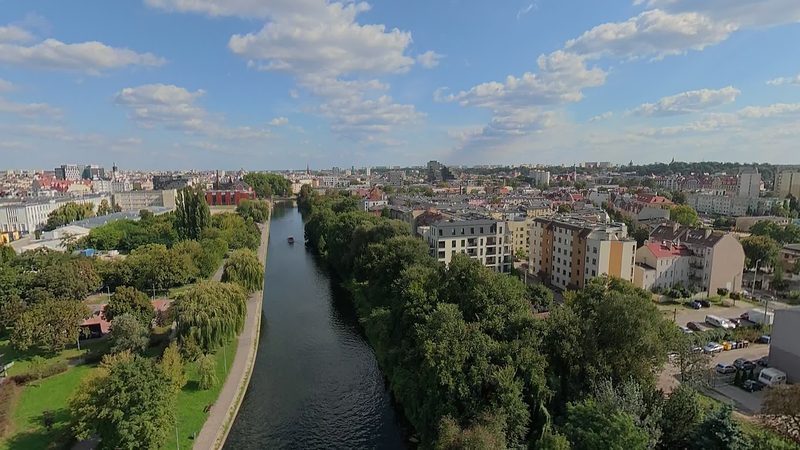
Околе и улица Локетка, Быдгощ — полёт 360° с гидом
- 8 мин
- 360° · 8K
- Открытые субтитры
- Онлайн с 7 октября 2026 г.
Последний трамвай на Околе ушёл в июне 1984 года. Помните?
О фильме
Линия шла по улице Грюнвальдской и исчезла, когда там перестроили кольцевую развязку. В этом фильме я пролетаю над Околе, улицей Локетка — бывшей Prinzenstrasse — и вдоль Брды до самого моста Королевы Ядвиги.
Гид рассказывает, в частности, почему Hala Astoria носит имя нью-йоркского отеля и кто держал ресторан на улице Локетка: с 1900 года и до начала войны это был Франц Будзбон. На нижней Брде верфь братьев Вульф когда-то строила большие салонные суда для Киева.
Покажите гостям и Околе. Этот район пережил Вторую мировую войну без разрушений, поэтому здесь стоят довоенные дома.
Места в фильме
- Околе (Okole) Карта
- Улица Локетка (ulica Łokietka) Карта
- Брда (Brda) Карта
- Мост Королевы Ядвиги Карта
- Hala Astoria Карта
Полный текст гида (на английском)
Why did Okole, the district below us, lose its tram? The line ran along Grunwaldzka Street, and when its roundabout was rebuilt, the line was scrapped: the last tram to Okole ran in June 1984.
Who was meant to move into Jasna Street, below us? The city decided to renovate the most run-down buildings in Okole, here on Jasna, and the flats inside them were meant for teachers.
Ahead, the Brda leads down toward Łokietka Street and the bridges, and across the water lies Bocianowo, the side of town that grew up around the railway station and later waited years for its trams to return.
Whose house has the longest facade of all the original buildings on Łokietka Street, below us, once called Prinzenstrasse? A widow's, and she was related to Ludwig Buchholz, who founded a successful tannery on Garbary Street.
Where did Łokietka Street go out to eat? From 1900 until the war broke out, Franz Budzbon, who also owned a house on Królowej Jadwigi Street, kept his restaurant in a building here.
Why is Hala Astoria, the rust-red pylons ahead, named like a New York hotel? Its club took the name of the Waldorf-Astoria in 1924, and its first president, Bernard Mrowiński, worked in the railway workshops.
Who brought chain towing to the Brda, the river below us? The Wulff brothers did, together with a banker, Aronsohn, and a senior machinist, launching it in 1870 and then helping it grow.
Big saloon ships for Kyiv were put together on the lower Brda. The Wulff brothers' shipyard built them for Lazar Brodzki's firm, after starting out with the Germania, a chain-driven river steamer that towed Vistula barges and rafts.
What did the war spare? Okole, along Łokietka Street below us: the whole district came through the Second World War unscathed, and then through the Soviet-era estate projects as well.
Far ahead, on the corner of Łokietka and Królowej Jadwigi, whose initials sit above the main entrance? Those of Carl Kaminski, a rentier and the first owner of the house, still held up by putti.
A bridge became a novel. Most Królowej Jadwigi, the dark span ahead, gave its name to an autobiographical novel by Jerzy Sulima-Kamiński, who lived near it most of his life.
Who was the first landlord of Number 12 on Łokietka Street, just ahead, a late Art Nouveau tenement? Auguste Lemke, and by trade he was a locomotive driver on the railway.
Why was no tram line laid along Królowej Jadwigi Street, straight ahead? The plans were turned down because they would have meant colossal demolition, and a route parallel to the street was built instead, opened in November 2012.
Why does Number 16 on Królowej Jadwigi Street, the red-brick house just ahead, still hold a medical centre? The Prussian state railways took it over, and later the Polish State Railways, PKP, set up an occupational medicine centre there.
At Hala Astoria, the rust-red steel on the bank, what became of the old Astoria? In 2017 it vanished, and in its place rose a new Olympic pool; with the modernist Astoria went its symbol, the Delfinki.
The town expected trams here. Work on Most Królowej Jadwigi, the white lamps straight ahead, began in May 1913, once its predecessor had been pulled down in 1912, and its deck was prepared for tram traction.
What has this corner block on Dworcowa been? Home to farm organisations and the Rzepicha restaurant in communist times, then a bank, and now, with new floors on top, the Modern Office, lit in red and blue.
What do you call the street to the station? Dworcowa, beyond the bridge, began as Bahnhofstraße; 1920 made it Dworcowa, 1939 made it Albert-Forster-Straße, and since the war it has been Dworcowa again.
Who opened the railway at the end of Dworcowa? The year 1851 brought King Wilhelm IV of Prussia to do it in person, and before the decorated station a folk troupe from Kujawy, in regional costume, sang in Polish.
When did trams first run along Dworcowa, beyond the river? From 1888, and at first they were pulled by horses, and only from 1896 did the cars run on electricity.
Why build Most Władysława Jagiełły, the white pylon ahead? When trams stopped running along Dworcowa in 1990, the station lost its link to the tram network, and for years the city argued over how to bring the line back.
Whose houses line Dworcowa, beyond the river? Few are by the architects Święcicki and Weidner: on Gdańska Street the pair designed dozens of buildings, but on Dworcowa they left only a handful of works.
Upstream, behind us, Łokietka Street and Okole fall away, and the new tram line runs on from the river toward the railway station, which the old trams had stopped reaching.
The trams are only half of the story of Dworcowa, just beyond the river, and the older half goes further back in time, to the days of the Prussian railway.
Why is the Prussian Eastern Railway Headquarters, the red-brick gables by the tram street, in Bydgoszcz? The directorate outgrew Nowy Rynek and the station, there was talk of another city, and, reportedly, director Albert von Maybach won a grand building.
Who drove the first tram across? When the line over Most Władysława Jagiełły, the white pylon beneath us, opened, the first car out was a restored historic Herbrand, and at its controls, to the passengers' surprise, sat President Bruski himself.
Как сделан фильм
8K (7680×3840), 60 кадров/с. Открытые субтитры на английском впечатаны в изображение: три копии вокруг обзора, одна — рядом с местом, о котором идёт речь. Озвучка — синтетический голос на английском.
Факты гида взяты из:
- Википедия (на польском): Okole (Bydgoszcz)
- Википедия (на английском): Władysława Łokietka street in Bydgoszcz
- Википедия (на польском): Hala Astoria w Bydgoszczy
- Википедия (на польском): Astoria Bydgoszcz
- Википедия (на польском): Most Królowej Jadwigi w Bydgoszczy
- Википедия (на польском): Stocznie w Bydgoszczy
Ко всем фильмамДля администрации городаФильмы для глухих и слабослышащих
Андрей Шрамко
Инженер и кинематографист, живу в Быдгоще. Снимаю 360° в движении с 2015 года.