Told from Above · серия Shramko 360
 Автор: Андрей Шрамко
Чижкувко и шлюз Чижкувко, Быдгощ — полёт 360° с гидом
- 10 мин
- 360° · 8K
- Открытые субтитры
- Онлайн с 7 ноября 2026 г.
Быдгощский Медзынь когда-то официально назывался Schleusendorf — «деревня шлюзов».
О фильме
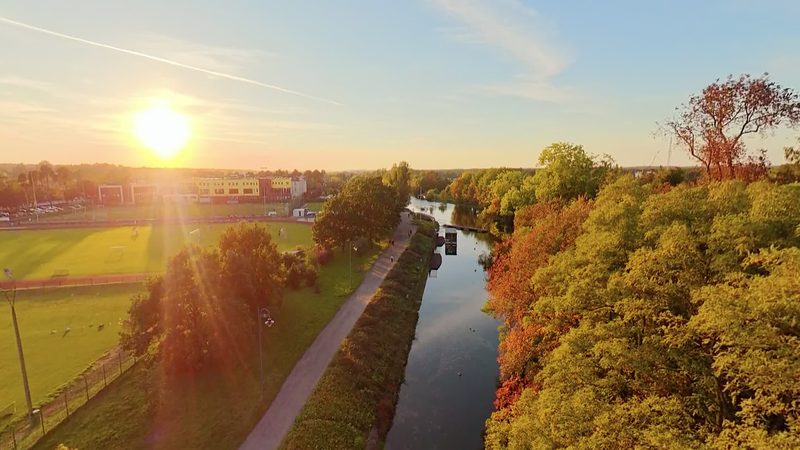
В этом фильме я лечу на закате над Быдгощским каналом: от шлюза VI Брониковского Старым каналом между деревьями парка, мимо Чижкувка к шлюзу Чижкувко и дальше новым каналом на запад, вдоль Медзыня, в сторону Осовой Гуры.
Гид рассказывает истории этих мест: как в 1646 году староста Францишек Оссолинский пожаловал мещанину Анджею Паулюсику участок с мельницей, как в 1713 году, во время Северной войны, Чижкувко стояло совсем пустым, как войт Станислав Понятовский, отец будущего короля, поселил в деревне Яна Кристиана Крига и как на углу Накельской и Брониковского когда-то стояла парашютная вышка, разобранная на лом в 1969 году.
Если будете в Быдгоще, встаньте у шлюза Чижкувко, когда проходит лодка: мостик на верхних воротах тогда уходит под воду, а нижний расходится в стороны вместе со створками ворот.
Места в фильме
- Шлюз VI Брониковского Карта
- Старый Быдгощский канал (Stary Kanał Bydgoski) Карта
- Чижкувко (Czyżkówko) Карта
- Шлюз Чижкувко (Śluza Czyżkówko) Карта
- Медзынь (Miedzyń) Карта
Полный текст гида (на английском)
Emergency use of the lock lasted until the late 1940s; final closure came in the late 1960s. Its chamber lies right below us. Until 1915, barges used Śluza VI Bronikowskiego; then new locks, among them Okole, opened.
Around the turn of the twentieth century, Wilke had a restaurant on Bronikowskiego, by the Old Canal, at the north-eastern edge of today's district. Carl Schüler's garden restaurant stood at the same time on today's Nakielska.
A parachute tower once rose by the corner of Nakielska and Bronikowskiego, brought to Miedzyń from Osiedle Leśne, where it had stood since 1936. Only in 1969 was it judged unnecessary and taken down for scrap.
Bydgoszcz's municipal building design office drew up plans for a tram line to Miedzyń, running along Nakielska as far as Łochowska street. It was dropped over high costs, including rebuilding the railway viaduct over Nakielska, which PKP opposed.
In 1646 the Bydgoszcz starost Franciszek Ossoliński granted a Bydgoszcz townsman, Andrzej Paulusik, a plot with a mill, under Dutch-style settler law, along with the right to build a paper mill.
In 1713 Czyżkówko stood completely deserted; before the Northern War, seven families had lived there. Under war burdens, people fled, or stayed too ruined to pay taxes. The miller later returned to a badly run-down mill.
Stanisław Poniatowski, reeve of Bydgoszcz and father of the future king Stanisław August, settled Jan Krystian Krig in the village under a Dutch-style rent contract. A miller later received a similar contract. Both owed the reeve taxes every year.
In the seventeenth century, dams at Flisy created the Górny, Sprzedni and Młyński ponds, which drove a mill and bred fish. When railway embankments took two of them, the mill got a motor and ran until 1951.
In 1961, Bydgoszcz's Miejska Rada Narodowa marked out plots for private houses, built with the residents' own money. Utilities and services did not follow: the main effort went to blocks of flats on the city's terraces, then to Fordon.
A boat takes about twenty minutes to pass Śluza Czyżkówko; meanwhile the footbridge on its upper gate sinks under the water, and the lower one swings aside with the gate leaves.
Miedzyń's official name was once changed to Schleusendorf, meaning the village of locks. Its Polish name comes from miedza, a border; trees and bushes were left standing on such borders, so the word could also mean a wood.
The Miedzyń lake vanished once the Bydgoszcz Canal was built: the land dried out and the groundwater fell. Schroetter's map shows the long lake by today's Spacerowa street; its loss was then counted as damage from the canal.
In 1969 the narrow-gauge station at Czyżkówko, part of the local commuter railway, closed because its route did not pay; Nad Torem street, meaning By the Track, owes its name to the vanished rails.
A Lidl discount store, the tenth in Bydgoszcz, opened in Okole on the site of a former station. That station was the starting point of the railway linking Bydgoszcz with Koronowo.
In April 1920 the gmina of Miedzyń was incorporated into Bydgoszcz, and later that month the city's oldest sports club, MKS Gwiazda, was founded there. Quite a few Germans lived in the gmina then, mostly on Inflancka, now Maciaszka.
Part of the singer Mrozu's video for his song Rollercoaster was shot at the abandoned pool of the Gwiazda Bydgoszcz facilities. The song comes from his album of the same title.
Building a hotel and a fuel station on part of the old bathing grounds wiped out the basin of the former pool. The firm Hurtostal then opened a shopping complex there, with a hotel and the Wodnik restaurant.
A new school on Pijarów street was due to open, but the first day of classes proved to be the first day of the Second World War. The Żwirko and Wigura school's brick building on Nakielska still stands.
In 2009 the slow pace of street building led the Rada Osiedla to vote for taking the district out of the city's administrative boundaries. It was only a symbolic gesture: the council has no such powers.
In November 1924, an explosion at the explosives processing plant in the forest east of Osowa Góra killed four people. Ammunition depots had already stood in that forest under Prussian rule.
The campaign for a pool in Miedzyń, begun in 1992, was still waiting in 2019, when, officially for lack of money, no tender was announced. From the start, the school got a boiler able to heat pool water too.
The evangelical church on Koronowska street was consecrated in November 1909, with the words Höre des Herrn Wort, hear the word of the Lord, over its entrance. Fighting damaged it in September 1939; today it houses the Iguś kindergarten.
When the owners of the Hoheneiche estate went bankrupt late in the nineteenth century, its land was sold off in plots. New names followed: Resztówka on the upper terrace, and Abisynia by the forest to the east.
Between the wars, the Ossowowie family's farm estate gave its name to the whole of today's neighbourhood, upper and lower terraces alike. Their farm was called Ossowagóra, in German Ossowerberg; its seat was a larch-wood manor.
German residents' donations paid for a red-brick building at Kruszyńska 52 that served at once as school, evangelical chapel and residents' meeting hall. The chapel had a ground-floor hall with stained glass.
When the village of Osowagóra became part of the Second Polish Republic, many Germans left for the Weimar Republic, selling their farms to Poles. Among the better-known new owners were Dobrogowski and Gorzelewski.
A nationwide conference on the city's public transport once produced plans for a tram line from the centre of Bydgoszcz. Its tracks to Osowa Góra were to run along Grunwaldzka street, but the plan was judged unprofitable.
A chapel of Blessed Maksymilian Kolbe opened in the neighbourhood, but the communist authorities shut it the following year; its priest was convicted for trying to enlarge it. Cardinal Wyszyński later erected the parish; Primate Glemp consecrated the church.
The Żołędowo forest district took over most of the former munitions complex and had it cleared of explosives, including German SD2 cluster bombs. Polish aircraft bombs turned up too: the oldest made in Poland, training models filled with tar.
During Bolesław Krzywousty's wars with Pomerania, the wooden-and-earth stronghold at Pawłówek was destroyed and abandoned. With Bydgoszcz and Wyszogród, Pawłówek is counted among the chief strongholds guarding crossings on the Kuyavian-Pomeranian border.
In 2019, university students proposed glazed restaurants, art galleries and kayak hire along the canal banks up to Śluza Osowa Góra.
Как сделан фильм
8K (7680×3840), 60 кадров/с. Открытые субтитры на английском впечатаны в изображение: три копии вокруг обзора, одна — рядом с местом, о котором идёт речь. Озвучка — синтетический голос на английском.
Факты гида взяты из:
Ко всем фильмамДля администрации городаФильмы для глухих и слабослышащих
Андрей Шрамко
Инженер и кинематографист, живу в Быдгоще. Снимаю 360° в движении с 2015 года.