Told from Above · a Shramko 360 series
 Author: Andrii Shramko
Piastowski Square, Bydgoszcz — a guided 360° flight
- 3 min
- 360° · 8K
- Open captions
- Online since 10 October 2026
Piastowski Square in Bydgoszcz started out as a market where mostly horses were traded.
About the film
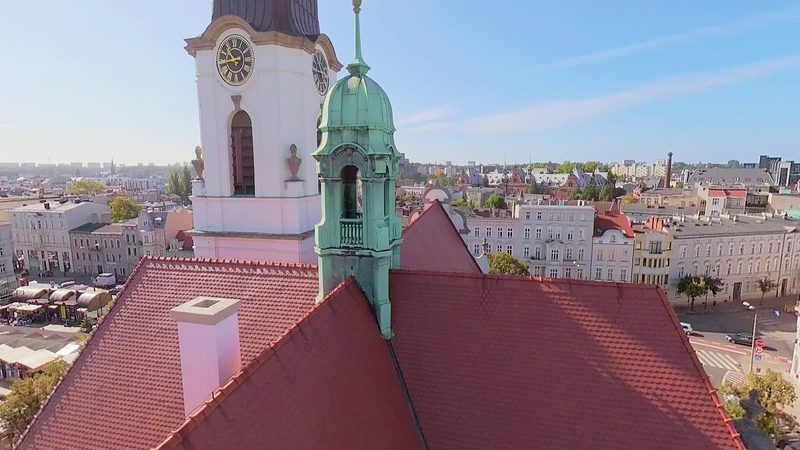
Around 1910 it was still called Elisabethmarkt, and other goods came only later. Today the market is run by the traders themselves: they founded Bydgoska Tradycja Bazarowa and won the tender. In this film I fly over the square, the market and the Church of the Saviour, whose architect once lost the competition for the Reichstag building.
One more story from the film: whole departments of the railway directorate, 300 railway staff, were moved from Gdańsk to the Railway Directorate Building in Bydgoszcz after the Danzig Senate protested to the League of Nations.
For visitors who want to see everyday Bydgoszcz, I recommend Piastowski Square and some shopping at the market.
Places in the film
- Piastowski Square Map
- Piastowski Square market Map
- Sacred Heart Church Map
- Church of the Saviour (Kościół Zbawiciela) Map
- Railway Directorate Building Map
The guide's full text (English)
Who did Sacred Heart answer to? Schimer wanted his church free of the Fara parish's authority, and the story goes he clashed so sharply with Beker that at some point the white church with the clock tower was even closed.
The square below us started out trading horses. Around 1910 Plac Piastowski was still Elisabethmarkt, and in its market part, curiously, mostly horses changed hands at first; only later did the goods on offer grow much wider.
Who designed Kościół Zbawiciela, the red-brick church with the tall tower? Heinrich Seeling from Berlin, author of the long-gone Teatr Miejski, the city theatre. In a contest to build the new Reichstag, Seeling had lost to Paul Wallot.
Privatisation put Hotel Brda, the tall grey blocks above the roofs, in the hands of an employee-owned company. With businessman Mirosław Ślachciak as its strategic investor, the company leased it along with the Ratuszowy and offices on Dworcowa Street.
Back at Sacred Heart, the white church below us, the security police arrested Jan Konopczyński, its priest, in 1950. He ran the parish on Plac Piastowski, had repaired its war damage, and his family's long efforts won his release.
After the war, Kościół Zbawiciela, the tall tower beyond the roofs, changed its name. Reverend Ryszard Trenkler from Toruń held the first post-war service, and that same year Kościół Chrystusa was won back and reconsecrated as the Saviour's.
Why did 300 railway staff leave Danzig for Bromberg? Budynek Dyrekcji Kolei, the red-brick palace beyond the houses. After Danzig's Senate protested to the League of Nations against its directorate running lines in Poland, whole departments were moved.
The traders themselves manage Targowisko na Placu Piastowskim, the covered stalls right below us. Wanting to run and modernise it on their own, they set up Bydgoska Tradycja Bazarowa, which won the tender against the previous leaseholder, Rohde.
Franciszek Poćwiardowski founded the KP bakery, and it is still family-run, in a tenement on Śniadeckich Street, while next door the ground floor holds the Żak ice-cream parlour, founded the very year the bakery moved in.
Traders, not a leaseholder, now run Targowisko themselves.
How the film was made
8K (7680×3840), 60 fps. Open captions in English, burned into the picture: three copies around the view, one next to the place being described. Narration: a synthetic voice in English.
The guide's facts come from:
Back to all filmsFor the cityFilms for deaf and hard-of-hearing viewers
Andrii Shramko
Engineer and filmmaker, living in Bydgoszcz. I have been filming 360° in motion since 2015.