Seria „Told from Above”
 Autor: Andrii Shramko
Wzgórze zamkowe i ulica Długa, Bydgoszcz — lot 360° z przewodnikiem
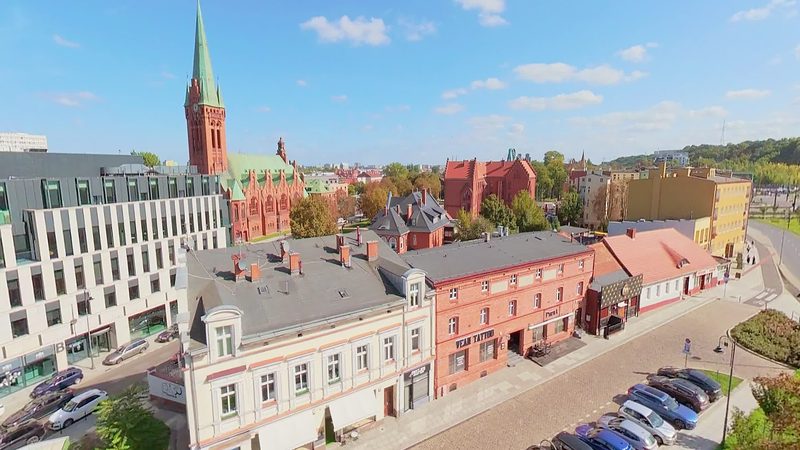
- 7 min
- 360° · 8K
- Napisy na ekranie
- Online od 8 października 2026
Tam, gdzie dziś stoi kościół św. Andrzeja Boboli, do 1656 roku stał zamek Kazimierza Wielkiego.
O filmie
W XIX wieku cegła z ruin zamku trafiła przede wszystkim do kamienic przy Długiej. W tym filmie lecę nad wzgórzem zamkowym, placem Kościeleckich i ulicą Długą.
Przewodnik opowiada m.in., dlaczego Podwale i Magdzińskiego nazywano kiedyś ulicą Żabią, jak król zastawił zamek, żeby spłacić dług, i jak twierdzę wysadzono w powietrze. W 1910 roku na Zbożowym Rynku wykopano skarb: 210 monet z X wieku.
Kto przyjedzie do Bydgoszczy, niech przejdzie się Długą: w tych kamienicach jest cegła z królewskiego zamku.
Miejsca w filmie
- Wzgórze zamkowe Mapa
- Kościół św. Andrzeja Boboli Mapa
- Plac Kościeleckich Mapa
- Ulica Długa Mapa
- Zbożowy Rynek Mapa
Pełny tekst przewodnika (EN)
A king's castle once stood where this church stands. Saint Andrew Bobola's, the red-brick tower with the green spire, rose on the levelled castle island, where the castle of King Casimir the Third stood until 1656 before sinking into ruin.
Frogs gave this corner of town an old street name. In old-Polish times Podwale and Magdzińskiego Street below us were known by exactly the same name, platea dicta Żabia, Frog Street.
Treasure has come out of the ground below us. On Zbożowy Rynek, the Grain Market, near where the early stronghold's settlement is thought to have stood, a hoard of 210 tenth-century coins was dug up in 1910.
Where did the castle go? Partly into the street below us. In the nineteenth century its brick went into many buildings, above all the tenements of Długa, and the last ruins came down in 1895.
Długa, the street under us now, has a habit of giving up pieces of older towns whenever it is dug up, and the next find is one that people still walk on.
Even the rails were recycled here. When Długa below us was dug up for roadworks, workers found tram tracks from 1957 and 1958 and set them into the cobbled surface the street got back after many years.
How many names can a square wear? This one was Hann von Weyhern Platz, after a Prussian cavalry general, then Plac Kościeleckich, the general's again, Plac Kościeleckich once more, and reportedly, for a few years, October Revolution Square.
Plac Kościeleckich is the Kościeleckis' square, and they were a king's creditors. In 1441 King Władysław Warneńczyk pawned the castle here to cover a debt, and from then on its royal governors came from that family.
Before the castle was pawned, it saw a siege: the Teutonic Knights held it, and Władysław Jagiełło, King of Poland, brought his army here to take it back from them.
Right here, Władysław Jagiełło made peace with the Teutonic Knights, for a while: he stormed the castle back in eight days and signed a truce with their Grand Master, Ulrich von Jungingen, to last until the following June.
How did the castle end? With a bang. In October 1656 Polish troops stormed it again, the Swedish garrison fought hard, and the fortress was blown up, taking the living wings and the bastions around the hill with it.
By now the royal castle had been fought over, pawned to its governors and finally blown up, and what the wars had left of it was about to be carted off, stone by stone, and put to ordinary uses.
Przy Zamczysku, the lane behind us, swapped between German and Polish names. Its name means By the Castle Ruins, but it began as Wiesestraße, and in the war years it was Schloßstraße, Castle Street, until the Polish name returned.
Before the letters came the hussars. Poczta Główna, the Main Post Office, the red-brick block with a sharp turret, stands where barracks were ordered for a squadron of hussars under General Małachowski.
Back at Saint Andrew Bobola's, the altar looks to Vilnius. The first Jesuits after the war, Father Władysław Wantuchowski and a fellow priest, both linked to Vilnius, set a copy of its Ostra Brama Madonna over the main altar.
Its classrooms once heard Polish and German side by side. Instytut Geografii, the geography institute, the brick block with the stepped gable, took in the Father Piramowicz school, while a German evangelical school kept a wing of it until 1930.
A procession through Bydgoszcz ended on the church steps with a service of atonement, handing the Protestant church to the Jesuits. Klasztor Ojców Jezuitów, their green-roofed house below us, was founded by Primate Hlond's decree of 1946.
This school building had a monastery for a neighbour. Wydział Rolnictwa, the agriculture faculty, the brick house behind the square, was raised from 1867 to 1872 for a flourishing evangelical seminary, next to the rebuilt monastery.
An industrialist and a socialist lent their names to Stary Port, the embankment street here. In the first half of the last century it honoured Herman Franke, honorary citizen of Bydgoszcz, and under communism the socialist Julian Marchlewski.
Politicians wrote the rules for this façade. Back at Poczta Główna, the post office with the sharp turret, Prussian parliament rules dictated the design, from neo-Gothic brick, counted a Prussian national style, to the use of rooms and courtyards.
No bridge in the country was built this way before. Most Bernardyński w Bydgoszczy, the Bernardine Bridge with tram tracks, rose from a moving scaffold, and its designer Maksymilian Wolff reportedly won second prize for it.
Jagiellońska, the street beyond, kept changing its name: from Wilhelmstraße to Jagiellońska and on to Hermann Göring Straße, back to Jagiellońska, and for a few years to Generalissimus Stalin Street.
Pałac Młodzieży lost its patron too: it bore Janek Krasicki's name only from 1977 to 1990.
Jak powstał film
8K (7680×3840), 60 kl./s. Napisy otwarte po angielsku — trzy kopie dookoła, jedna przy opisywanym miejscu. Narracja: głos syntetyczny (EN).
Fakty przewodnika — ze źródeł:
Wszystkie filmy o mieścieDla urzędu miastaFilmy z napisami dla osób niesłyszących
Andrii Shramko
Inżynier i filmowiec, mieszkam w Bydgoszczy. 360° w ruchu filmuję od 2015 r.