Seria „Told from Above”
 Autor: Andrii Shramko
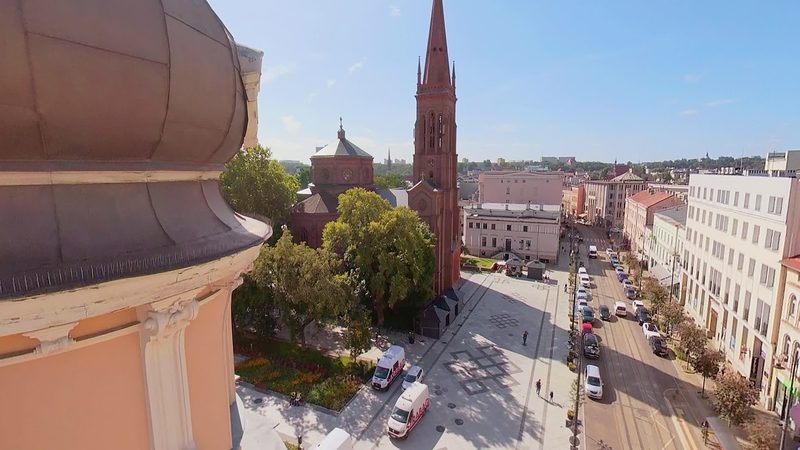
Plac Wolności i park Kazimierza Wielkiego, Bydgoszcz — lot 360° z przewodnikiem
- 5 min
- 360° · 8K
- Napisy na ekranie
- Online od 9 października 2026
Kto zapłacił za Łuczniczkę, która stała się symbolem Bydgoszczy?
O filmie
Bankier Lewin Louis Aronsohn, dla którego zbudowano żółtą willę z rzeźbionymi szczytami. To on sfinansował pracę rzeźbiarza nad posągiem. W tym filmie lecę nad placem Wolności i parkiem Kazimierza Wielkiego.
Przewodnik opowiada m.in., z czyjej inicjatywy odbudowano fontannę Potop i dlaczego właściciele kamienicy Oskara Ewalda chcieli zatrzymać windę do pracowni pierwszej polskiej fotografki w mieście. W kamienicy Georga Sikorskiego, tej z drewnianym balkonem, działał Kosmyk, najstarszy salon fryzjerski w Bydgoszczy, z tradycją sięgającą 1878 roku. Zamknięto go pod koniec marca 2017.
Z drona widać, jak gęsto kamienice otaczają plac. Warto obejść go dookoła także na piechotę.
Miejsca w filmie
- Plac Wolności Mapa
- Park Kazimierza Wielkiego Mapa
- Willa Aronsohna Mapa
- Fontanna Potop Mapa
- Łuczniczka Mapa
Pełny tekst przewodnika (EN)
Who paid for the statue that became this city's symbol? Willa Aronsohna, the yellow villa with carved gables, was built for a Jewish banker, Lewin Louis Aronsohn, who funded the work of a sculptor creating The Archer.
Why would landlords stop their own lift? At Kamienica Oskara Ewalda, the grey corner house with oval windows, the lift carried clients up to Władysława Spiżewska, the town's first Polish woman photographer, and the owners wanted her studio closed.
Where did the oldest hair salon in Bydgoszcz close? Kamienica Georga Sikorskiego, the beige house with a wooden balcony. Kosmyk, the salon with a tradition going back to 1878, closed its doors here at the end of March 2017.
A tenant here got a British nickname. The ochre house with an onion dome, Freedom Square 1, Bydgoszcz, housed Alexander von Kluck, a Fusiliers colonel. Kluck's army fought at the Marne, and the British called him old one o'clock.
Who strips a renovated façade bare? Kamienica Carla Meinhardta, the cream house with a rounded attic, was renovated until 1974, when Edward Gierek, the Party leader, visited the city, and for the occasion all its sculptures came off.
Who built Jedynak, the pale ribbed block? The Conitzers, a wealthy Jewish merchant family, who hired Otto Walter, a Berlin architect. Between the wars, as Be-De-Te, the department store was famous for its fashion shows.
Joseph Stalin nearly took this spot. Sts. Peter and Paul Church, the red-brick one with the tall tower, was to make way for a Stalin monument, but its parishioners and their priest, Stanisław Wiśniewski, stood firm.
Whose club was this? The white building with a balustrade, now Sala Kameralna Akademii Muzycznej, housed the German elite's Erholung Casino; after Hitler took power it barred Polish groups, and its renaming as Social House drew violent German protests.
Who was buried in Plac Wolności, Freedom Square, below us? Red Army men led by Colonel Grigorij Bolszanin, laid to rest near the spot where the statue of Emperor William the First on his horse had stood.
Campaigning for an election boycott, Solidarity activists let a pig loose on Plac Wolności, behind us, with I'm going to vote written on its side. Chased by the ZOMO, it fled to Śniadeckich Street, where a net finally caught it.
Who was barred from Park Kazimierza Wielkiego, beside us? The townspeople. Once the Prussians secularized the order, the regional office made its garden a District Park, Regierungs Garten, closed to residents, and swans and carp were bought for its ponds.
Picasso and Warhol have both been shown here. Galeria Miejska BWA, the pale curved pavilion by the park, also works with the Camerimage festival, and with it has shown David Lynch's lithographs and Andrzej Wajda's drawings.
Who brought this fountain back? Potop, the Deluge Fountain, the bronze figures between the trees, was dismantled in January 1943 so the German occupiers could melt it down, and a famous surgeon, Zygmunt Mackiewicz, initiated its rebuilding.
Who designed this office tower? The engineer Bronisław Jabłonka drew up Konarskiego 1, the white tower behind the curved block. A memorial stone set in 1998 recalls the Bydgoszcz events of March 1981.
Why did the militia charge here? Gmach Rejencji, now the Voivodeship Office, the white classical block by the park, filled with union men at Jan Rulewski's call; Lech Wałęsa urged Rulewski to leave, and the militia beat him.
Whose names are cast in brass here? Bydgoskie Centrum Finansowe, the long block with grey cladding, was a printing house, and a plaque on its Gdańska side names Bydgoszcz printers, booksellers, librarians and journalists murdered by the Nazis.
Who led the bricklaying on Poczta Główna, the gabled red-brick building? Mainly Paul Bohm, a Bydgoszcz master bricklayer, with joinery from Eberswalde. The post office has kept its 1899 shape almost unchanged, down to its original metal railings.
Jak powstał film
8K (7680×3840), 60 kl./s. Napisy otwarte po angielsku — trzy kopie dookoła, jedna przy opisywanym miejscu. Narracja: głos syntetyczny (EN).
Fakty przewodnika — ze źródeł:
Wszystkie filmy o mieścieDla urzędu miastaFilmy z napisami dla osób niesłyszących
Andrii Shramko
Inżynier i filmowiec, mieszkam w Bydgoszczy. 360° w ruchu filmuję od 2015 r.