Told from Above · серия Shramko 360
 Автор: Андрей Шрамко
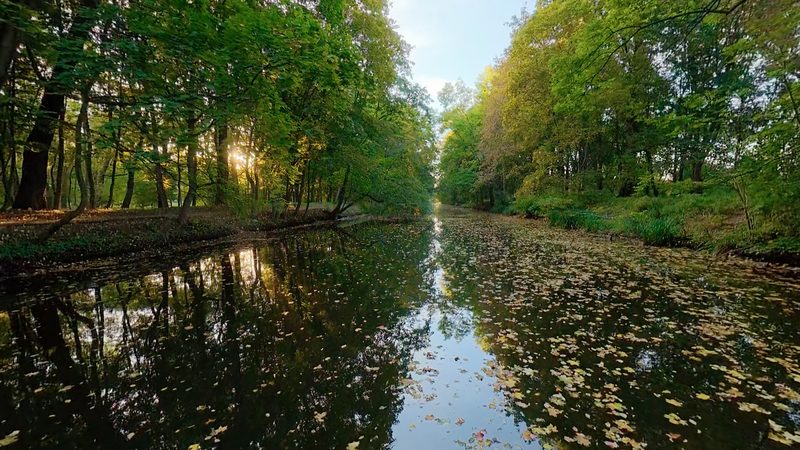
Старый канал и парк над каналом, Быдгощ — полёт 360° с гидом
- 8 мин
- 360° · 8K
- Открытые субтитры
- Онлайн с 3 ноября 2026 г.
Быдгощский канал обычно приписывают Бренкенхоффу и прусскому королю, а идея, скорее всего, принадлежала дорожному мастеру Герману Явейну.
О фильме
В этом фильме я лечу низко над Старым Быдгощским каналом, между деревьями парка, до низкого железнодорожного моста, а в конце поднимаюсь над кронами.
Гид рассказывает о жизни канала: о деревьях на берегах, посаженных по идее инспектора канала Эрнста Конрада Петерсона, о сплаве леса до самых Берлина и Гамбурга, о том, как после 1915 года старый участок превратили в рыбные пруды и парк, и о легенде, откуда взялось название Вильчак. До 1805 года на холме в Вильчаке казнили: это была Виселичная гора, позже переименованная в Княжеский холм.
Если будете в Быдгоще, пройдитесь вдоль Старого канала до железнодорожного моста: пешеходы и велосипедисты до сих пор проходят там сквозь насыпь кирпичными сводами.
Места в фильме
- Старый Быдгощский канал (Stary Kanał Bydgoski) Карта
- Парк над каналом Карта
- Околе (Okole) Карта
- Вильчак (Wilczak) Карта
Полный текст гида (на английском)
Kanał Bydgoski lies where the Noteć and the Brda come closest; King Władysław IV Vasa had proposed joining them, and the canal brought back an Ice Age pattern, when the Vistula flowed west to the North Sea.
Boats may have passed here long before the canal: an anchor turned up where Grunwaldzka Street runs today, and near Łochowo village the remains of a large ship and a landing stage were dug up.
King Stanisław August Poniatowski's advisers wanted such a canal too: Polish goods would reach western Europe and Gdańsk would lose its monopoly. The only objection was political, the fear of making Prussia stronger.
Brenckenhoff and the Prussian king usually get the credit for this water, but most likely the idea came from Herman Jawein, a road master who, touring land Prussia had seized, saw how much meadow a drained valley would yield.
The tall trees that lean over this water go back to an idea of the canal's inspector, Ernst Conrad Peterson: systematic planting along the Bydgoszcz stretch of its banks began early in the nineteenth century.
He had first come to Bydgoszcz invited by his half-brother, Johann Philip, who was extending and repairing this canal under his mentor, David Gilly; at first he worked on the site as an apprentice.
In the Czyżkówko legend, a blacksmith's hut was the finest on the road to Koronowo. A young knight stopped to shoe his horse, fell for a girl playing with a caged siskin, and resolved to write her a letter.
The new canal sliced up the fields of the Czyżkówko manor farm, and parts of its land went to Miedzyń and Okole; by 1791, families from Germany had been settled there and a paper mill founded.
Steamships came to this narrow water, now covered in leaves, only after 1885, and in those years the whole canal carried, on average, about 500 thousand tonnes of goods a year.
Where leaves float now, rafts once did: by the end of the nineteenth century Bydgoszcz had more people working in shipping and rafting than Gdańsk, and timber floated along this canal to Berlin and Hamburg.
On the Wilczak side, the factory of Carl Blumwe, which his son Wilhelm ran from 1887, grew on the timber boom: wood from Congress Poland went by water, down the Vistula and along this canal, to the German Empire.
Leaves drift on the dark water here. In 1899 Ernst Heinrich Peterson published excerpts from the diary his grandfather had kept as an engineer on Kanał Bydgoski, in the journal of a Bromberg historical society.
Brick workers lived here too: on his Czyżkówko land, the same Ernst Heinrich built them the first workers' estate in town, and since their homes had no sewers, he added a bathhouse with a swimming pool.
The new waterway opened on the first of April 1915, but the war halted traffic. This stretch was kept in reserve, and the city made it fish ponds with plantings, the park on the Bydgoszcz Canal, now a protected nature area.
Among the Nazi authorities' plans was a bypass canal around Bydgoszcz, the so-called coal canal, running from the Osowa Góra lock along the foot of the valley's northern slope to the Vistula, north of Fordon.
The Second World War left the canal unharmed, apart from vandalism by Red Army soldiers; the hero of the first post-war months was Stanisław Tychoniewicz of the State Water Board, who fought to save it from their lawlessness.
In 2018 Bydgoszcz residents voted for this canal: renewing the embankment of Stary Kanał Bydgoski between the fourth and fifth locks won the most votes, nearly 4.3 thousand, in the city's civic budget.
Starting in 2008, an EU project called Reuris landscaped part of the filled-in canal east of the fourth lock, with plants, steps, terraces and small footbridges, whose tempered-glass railings were smashed and replaced with metal mesh.
Since 2007, marathons have been run along Stary Kanał Bydgoski every year, among them the Night Marathon of the Bydgoszcz Canal, whose lap of 4.2195 kilometres is exactly a tenth of the full distance.
Until 1805, a hill in Wilczak was a place of execution, known as Gallows Hill; the executioners lived close by, and the land registers went on naming them until 1858.
In the Czyżkówko colony, renamed Jägerhof by the Prussians, Max Krüger ran a steam mill and a distillery of rum and liqueurs; the mill worked into the 1950s and burned twice before it was pulled down.
Between the wars there were bathing places on the Brda, among them the Riwiera, where Jasna Street meets the river, with boats and kayaks for hire; facing it stood the so-called military bathing place.
When the railway to Inowrocław arrived in 1872, its builders set Most kolejowy nad starym kanałem, the low bridge far ahead, into the embankment, and made its main span of steel girders.
In 1911 the School of Crafts and Artistic Industry moved into its new home on the canal bank, mirrored in the water and set in a park; in 1915 the school became a college.
That same Gallows Hill, Galgenberg in German, got a new name after the heir to the Prussian throne, later King Frederick William IV, stayed there in June: from then on it was Prince's Hill, Prinzenhöhe.
Wilczak, says a legend in Sławiński's 1935 collection, goes back to an old knight who, with his sons and servants, turned back the wagons of Teutonic merchants rolling out of Kuyavia, and he came to be called a wolf.
Walkers and cyclists still cross the embankment of Most kolejowy nad starym kanałem by brick vaults, 3.9 metres wide, 20 metres away.
Как сделан фильм
8K (7680×3840), 60 кадров/с. Открытые субтитры на английском впечатаны в изображение: три копии вокруг обзора, одна — рядом с местом, о котором идёт речь. Озвучка — синтетический голос на английском.
Факты гида взяты из:
Ко всем фильмамДля администрации городаФильмы для глухих и слабослышащих
Андрей Шрамко
Инженер и кинематографист, живу в Быдгоще. Снимаю 360° в движении с 2015 года.