Told from Above · серия Shramko 360
 Автор: Андрей Шрамко
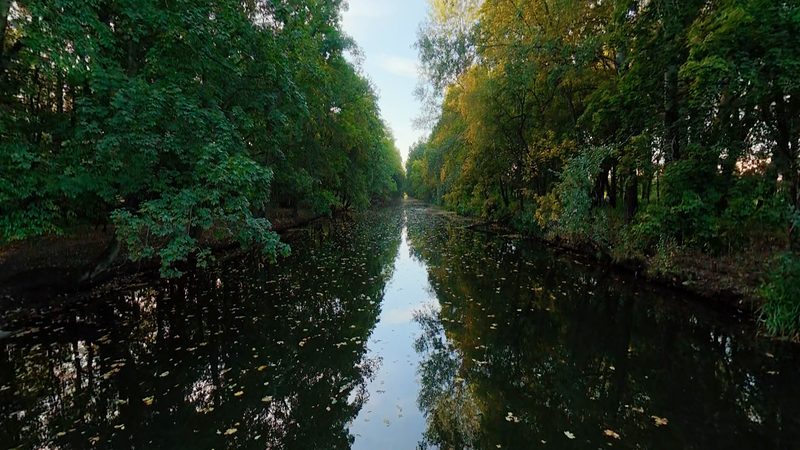
Старый Быдгощский канал и Планты, Быдгощ — полёт 360° с гидом
- 5 мин
- 360° · 8K
- Открытые субтитры
- Онлайн с 25 октября 2026 г.
Быдгощский канал выкопали за год: с весны 1773 года до открытия в июне 1774 года — ценой жизни 2000 рабочих.
О фильме
Копать канал привезли 8000 рабочих из Мекленбурга, Тюрингии, Саксонии и даже из Чехии. Канал позволил баржам идти из Вислы в Щецин, не огибая Балтику морем. В этом фильме я пролетаю низко над водой Старого Быдгощского канала, вдоль Плант на Околе.
Гид рассказывает, в частности, о польском проекте канала 1766 года, который перечеркнули Барская конфедерация и первый раздел Польши, об инспекторе Петерсоне, который перестроил шлюзы из кирпича и заложил нынешние Планты, и о том, как Околе стало Канальным островом. У пятого шлюза когда-то стоял ресторан с танцевальным залом и садом, который называли Цветочным шлюзом.
Если приедете в Быдгощ, пройдитесь по Плантам вдоль Старого канала. Большинство деревьев, посаженных Обществом украшения города, основанным в 1832 году, до сих пор стоят здесь.
Места в фильме
- Старый Быдгощский канал (Stary Kanał Bydgoski) Карта
- Планты над Быдгощским каналом Карта
- Околе (Okole) Карта
Полный текст гида (на английском)
In 1766 the royal geographer Franciszek Czaki laid a Polish plan for a canal here, locks and all, before the Crown Treasury Commission. The Sejm was to approve it, but the Bar Confederation and the first partition of Poland came first.
Digging began in spring 1773, and eight thousand labourers were brought to this valley from far away to dig it: from Mecklenburg, Thuringia and Saxony, from Dessau, and even from Bohemia.
Fever and dysentery killed two thousand of the workers, and the survivors were ordered to settle along the canal, which let barges sail from the Vistula to Szczecin without going round the Baltic.
Within a year all the locks were ready, and on 14 June 1774 the Kanał Bydgoski, the Bydgoszcz Canal, officially opened. Boats began passing in September, while the locks were strengthened and the bed deepened into the next year.
In 1792 a shipment of grain for the army, sent west from the Vistula, ended in failure, and it was that failure which moved the Prussian authorities to pay for modernising the canal.
At first no trees grew here: the canal ran along the floor of the Toruń–Eberswalde glacial valley, through peat bogs and meadows on sand, and trees were planted on its banks to stop them washing away.
Inspector Ernst Conrad Peterson rebuilt the canal's locks in fired brick, the first such locks in Germany, and laid out the park known today as Planty nad Kanałem Bydgoskim; original chambers from his time still stand on this canal.
From the start the canal was short of water, worst on its highest stretch, between the Osowa Góra and Józefinki locks, so Lake Ślesińskie was lowered and cut through to the Noteć near Nakło.
In 1832 Bydgoszcz founded a Towarzystwo Upiększania Miasta, a Town Beautification Society, a model for other Prussian towns, and soon it planted trees along the canal from the second lock to the sixth; most still stand.
The first large pavilion restaurant, with a dance hall and a garden restaurant, was built by the fifth lock and went by the name Śluza Kwiatowa, the Flower Lock, or Blumenschleuse in German.
Berlin approved a Central Canal joining the Rhine, the Oder and the Vistula, so this canal had to take bigger barges, spurred by rumours that Russia's emperor meant to dig a rival waterway between the Vistula and the Warta.
Early in the twentieth century the canal got a new cut, and this stretch in the park was retired: it became Stary Kanał Bydgoski, the Old Canal, and Okole became Wyspa Kanałowa, the Canal Island, ringed by water.
When Bydgoszcz returned to Poland, the canal's inspector was the businessman Józef Bronikowski, but the new border with Germany now cut across the waterway, and high customs duties dictated by the German side choked its trade.
For 150 years these banks were counted as home to the second-largest colony of thrush nightingales in Europe, and black poplars here grew 36 metres tall, the giants of this park.
When the Second World War broke out, Polish sappers damaged the Czyżkówko lock; then through the war the canal worked hard, carrying bulk cargo, because the railways were kept for war supplies.
Halfway along one of the park's avenues, the town once set up a monument to Franz von Brenckenhoff, the co-creator of the canal we have been flying along.
Как сделан фильм
8K (7680×3840), 60 кадров/с. Открытые субтитры на английском впечатаны в изображение: три копии вокруг обзора, одна — рядом с местом, о котором идёт речь. Озвучка — синтетический голос на английском.
Факты гида взяты из:
Ко всем фильмамДля администрации городаФильмы для глухих и слабослышащих
Андрей Шрамко
Инженер и кинематографист, живу в Быдгоще. Снимаю 360° в движении с 2015 года.