Told from Above · a Shramko 360 series
 Author: Andrii Shramko
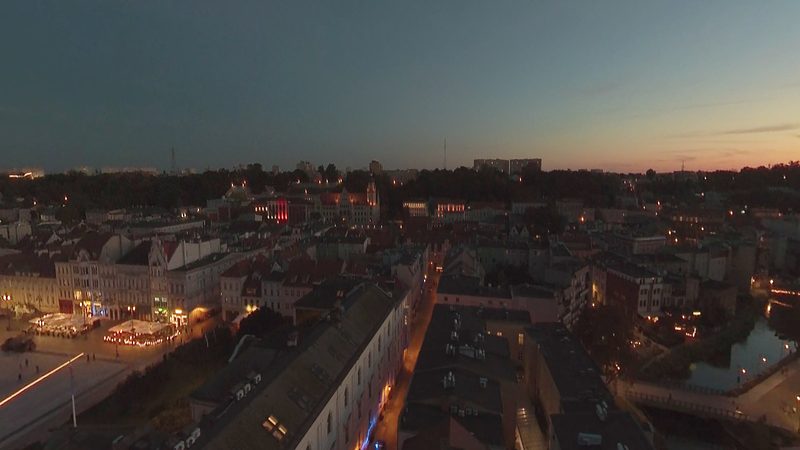
Opera Nova and Mill Island by night, Bydgoszcz — a guided 360° flight
- 5 min
- 360° · 8K
- Open captions
- Online since 20 October 2026
They say these three bronze women by the Brda look so sad because the shops had nothing but vinegar.
About the film
This is "Three Graces" by Jerzy Buczkowski, unveiled in 1989 by the Old Port. In this film I fly over Bydgoszcz at night, from Opera Nova and Mill Island to the Rother Mills, the cathedral and the Old Market Square.
The guide tells, among other things, how President Stanisław Wojciechowski sailed to the regatta at Brdyujście aboard the Lloyd Bydgoski steamer "Wisła", and why one of the bridges was once called the port bridge: past the lock, boats sailed the Bydgoszcz Canal all the way to Berlin.
If you are ever in Bydgoszcz, visit the Granaries on the Brda (Spichrze nad Brdą). The merchant Samuel Gottlob Engelmann built them on Grodzka Street, and grain was stored in them for over a century and a half.
Places in the film
- Opera Nova Map
- Mill Island (Wyspa Młyńska) Map
- Rother Mills (Młyny Rothera) Map
- Bydgoszcz Cathedral Map
- Old Market Square (Stary Rynek) Map
- Granaries on the Brda (Spichrze) Map
- Three Graces sculpture (Trzy Gracje) Map
The guide's full text (English)
Hermann Göring once even lent his name to the bridges below us, between the Wilhelmsbrücke and the Red Army. Marshal Foch gave them his name again and again, and today they are named for Solidarity.
The first wooden City Lock, opened with the Bydgoszcz Canal, collapsed in the year 1788; its timber successor fell in again in the year 1803, and still the builders chose wood once more.
Ships once waited here for their turn at the City Lock. That is why one of the Solidarity Bridges was called the Hafenbrücke, the port bridge: after the lock, boats sailed the Bydgoszcz Canal all the way to Berlin.
Józef Chmiel, architect of Gdynia's musical theatre, drew Opera Nova as four circles in the Brda's bend. It took thirty-four years to build, and only Lublin's musical theatre took longer. Its cream rings curve along the river.
After many failures and landslides, builders raised the masonry Trapezoid Lock beside the City Lock of the Bydgoszcz Canal in the year 1884; buried later, its walls and chamber were uncovered for visitors in the year 2014.
How far did grain milled on Wyspa Młyńska travel? A consortium with the Schickler brothers of Berlin took over its mills, and their Herkules company served Germany, Britain and even Brazil.
Between the wars, boat trips to the rowing regattas at Brdyujście became a Bydgoszcz tradition, and in September President Stanisław Wojciechowski himself came from Warsaw and sailed to the races aboard the Lloyd Bydgoski steamer Wisła.
The story goes that Jerzy Buczkowski's bronze Trzy Gracje, unveiled on the Old Port quay in the year 1989 when shops held only vinegar, are three women who froze in sad poses, pondering what to cook for dinner.
Christian von Rother, a Prussian minister of agriculture, gave his name to Młyny Rothera. Warsaw architects Bulanda and Mucha once drew plans to turn them into a luxury hotel. Dark brick mill halls carry a glass top.
Between the wars, quiet Przyrzecze Street became a refuge for the Bydgoszcz underworld, and under the occupation the authorities allowed it to go on, renaming the lane Flunderweg, the road of flounders.
The town's first mayors, Jan Kiesselhuth and Konrad, founded Bydgoszcz Cathedral as a parish church together with the parish, right after the town itself had been founded. Its stepped red gable glows below us.
Frederick the Great's statue stood on the Old Market Square until German townspeople took it down and carried it off to Piła as the Versailles Treaty was signed. The lit square lies beyond the roofs.
When the Holiday Inn hotel went up at the corner of Grodzka and Bernardyńska streets in the year 2007, archaeologists opened new excavations within the early medieval stronghold that once stood there.
Merchant Samuel Gottlob Engelmann built the Granaries in Bydgoszcz on Grodzka Street, and for more than a century and a half they served as grain warehouses. Their dark timber frames stand on the water.
The secret police ransacked the first Bydgoszcz headquarters of Solidarność in December 1981 and closed it; before the union's regional board moved in, the inter-factory founding committee had worked in the same house.
Werner Kampe, the occupation's lord mayor and NSDAP district leader, ordered the whole west side of the Old Market torn down, and the house of the City Museum went with it.
In 1579 every sixth ship sailing down to Gdańsk came from Bydgoszcz.
How the film was made
8K (7680×3840), 60 fps. Open captions in English, burned into the picture: three copies around the view, one next to the place being described. Narration: a synthetic voice in English.
The guide's facts come from:
Back to all filmsFor the cityFilms for deaf and hard-of-hearing viewers
Andrii Shramko
Engineer and filmmaker, living in Bydgoszcz. I have been filming 360° in motion since 2015.