Told from Above · a Shramko 360 series
 Author: Andrii Shramko
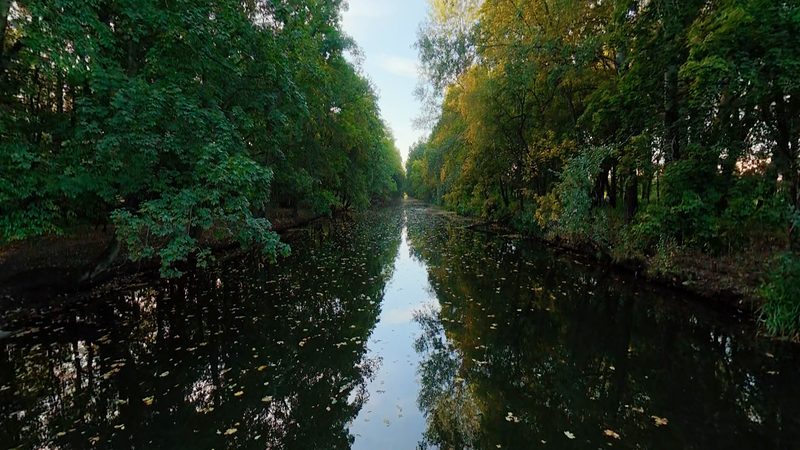
Old Bydgoszcz Canal and the Planty, Bydgoszcz — a guided 360° flight
- 5 min
- 360° · 8K
- Open captions
- Online since 25 October 2026
The Bydgoszcz Canal was dug in a year, from spring 1773 to its opening in June 1774, at the cost of 2,000 workers' lives.
About the film
As many as 8,000 workers were brought from Mecklenburg, Thuringia, Saxony and even Bohemia to dig it. The canal let barges sail from the Vistula to Szczecin without going round the Baltic. In this film I fly low over the water of the Old Bydgoszcz Canal, along the Planty park in Okole.
The guide talks, among other things, about a Polish canal project from 1766 that was wiped out by the Bar Confederation and the First Partition, about inspector Peterson, who rebuilt the locks in brick and laid out today's Planty, and about how Okole became Canal Island. By the fifth lock there once stood a restaurant with a dance hall and a garden, known as the Flower Lock (Blumenschleuse).
If you are ever in Bydgoszcz, walk the Planty along the Old Canal. Most of the trees planted by the Town Beautification Society, founded in 1832, are still standing.
Places in the film
The guide's full text (English)
In 1766 the royal geographer Franciszek Czaki laid a Polish plan for a canal here, locks and all, before the Crown Treasury Commission. The Sejm was to approve it, but the Bar Confederation and the first partition of Poland came first.
Digging began in spring 1773, and eight thousand labourers were brought to this valley from far away to dig it: from Mecklenburg, Thuringia and Saxony, from Dessau, and even from Bohemia.
Fever and dysentery killed two thousand of the workers, and the survivors were ordered to settle along the canal, which let barges sail from the Vistula to Szczecin without going round the Baltic.
Within a year all the locks were ready, and on 14 June 1774 the Kanał Bydgoski, the Bydgoszcz Canal, officially opened. Boats began passing in September, while the locks were strengthened and the bed deepened into the next year.
In 1792 a shipment of grain for the army, sent west from the Vistula, ended in failure, and it was that failure which moved the Prussian authorities to pay for modernising the canal.
At first no trees grew here: the canal ran along the floor of the Toruń–Eberswalde glacial valley, through peat bogs and meadows on sand, and trees were planted on its banks to stop them washing away.
Inspector Ernst Conrad Peterson rebuilt the canal's locks in fired brick, the first such locks in Germany, and laid out the park known today as Planty nad Kanałem Bydgoskim; original chambers from his time still stand on this canal.
From the start the canal was short of water, worst on its highest stretch, between the Osowa Góra and Józefinki locks, so Lake Ślesińskie was lowered and cut through to the Noteć near Nakło.
In 1832 Bydgoszcz founded a Towarzystwo Upiększania Miasta, a Town Beautification Society, a model for other Prussian towns, and soon it planted trees along the canal from the second lock to the sixth; most still stand.
The first large pavilion restaurant, with a dance hall and a garden restaurant, was built by the fifth lock and went by the name Śluza Kwiatowa, the Flower Lock, or Blumenschleuse in German.
Berlin approved a Central Canal joining the Rhine, the Oder and the Vistula, so this canal had to take bigger barges, spurred by rumours that Russia's emperor meant to dig a rival waterway between the Vistula and the Warta.
Early in the twentieth century the canal got a new cut, and this stretch in the park was retired: it became Stary Kanał Bydgoski, the Old Canal, and Okole became Wyspa Kanałowa, the Canal Island, ringed by water.
When Bydgoszcz returned to Poland, the canal's inspector was the businessman Józef Bronikowski, but the new border with Germany now cut across the waterway, and high customs duties dictated by the German side choked its trade.
For 150 years these banks were counted as home to the second-largest colony of thrush nightingales in Europe, and black poplars here grew 36 metres tall, the giants of this park.
When the Second World War broke out, Polish sappers damaged the Czyżkówko lock; then through the war the canal worked hard, carrying bulk cargo, because the railways were kept for war supplies.
Halfway along one of the park's avenues, the town once set up a monument to Franz von Brenckenhoff, the co-creator of the canal we have been flying along.
How the film was made
8K (7680×3840), 60 fps. Open captions in English, burned into the picture: three copies around the view, one next to the place being described. Narration: a synthetic voice in English.
The guide's facts come from:
Back to all filmsFor the cityFilms for deaf and hard-of-hearing viewers
Andrii Shramko
Engineer and filmmaker, living in Bydgoszcz. I have been filming 360° in motion since 2015.