Seria „Told from Above”
 Autor: Andrii Shramko
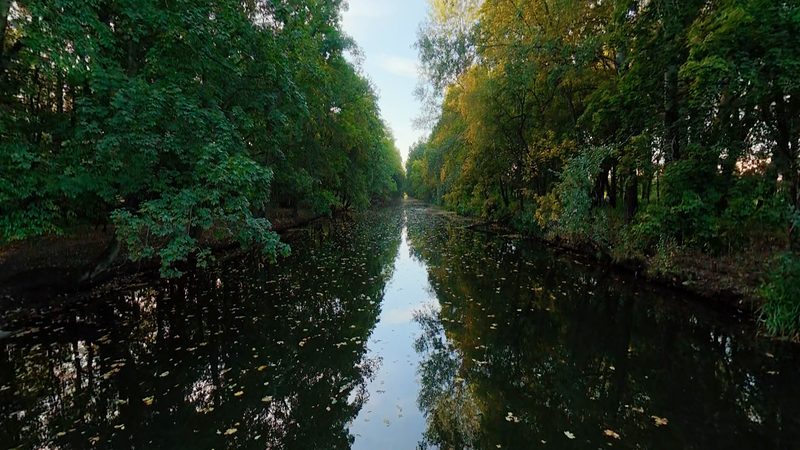
Stary Kanał Bydgoski i Planty, Bydgoszcz — lot 360° z przewodnikiem
- 5 min
- 360° · 8K
- Napisy na ekranie
- Online od 25 października 2026
Kanał Bydgoski wykopano w rok: od wiosny 1773 do otwarcia w czerwcu 1774 — kosztem życia 2000 robotników.
O filmie
Do kopania sprowadzono 8000 robotników z Meklemburgii, Turyngii, Saksonii, a nawet z Czech. Kanał pozwolił barkom płynąć z Wisły do Szczecina bez opływania Bałtyku. W tym filmie lecę nisko nad wodą Starego Kanału Bydgoskiego, wzdłuż Plant na Okolu.
Przewodnik opowiada m.in. o polskim projekcie kanału z 1766 roku, który przekreśliły konfederacja barska i pierwszy rozbiór, o inspektorze Petersonie, który przebudował śluzy z cegły i założył dzisiejsze Planty, oraz o tym, jak Okole stało się Wyspą Kanałową. Przy piątej śluzie stała kiedyś restauracja z salą taneczną i ogrodem, nazywana Śluzą Kwiatową.
Kto przyjedzie do Bydgoszczy, niech przejdzie się Plantami wzdłuż Starego Kanału. Większość drzew posadzonych przez Towarzystwo Upiększania Miasta, założone w 1832 roku, wciąż tu stoi.
Miejsca w filmie
Pełny tekst przewodnika (EN)
In 1766 the royal geographer Franciszek Czaki laid a Polish plan for a canal here, locks and all, before the Crown Treasury Commission. The Sejm was to approve it, but the Bar Confederation and the first partition of Poland came first.
Digging began in spring 1773, and eight thousand labourers were brought to this valley from far away to dig it: from Mecklenburg, Thuringia and Saxony, from Dessau, and even from Bohemia.
Fever and dysentery killed two thousand of the workers, and the survivors were ordered to settle along the canal, which let barges sail from the Vistula to Szczecin without going round the Baltic.
Within a year all the locks were ready, and on 14 June 1774 the Kanał Bydgoski, the Bydgoszcz Canal, officially opened. Boats began passing in September, while the locks were strengthened and the bed deepened into the next year.
In 1792 a shipment of grain for the army, sent west from the Vistula, ended in failure, and it was that failure which moved the Prussian authorities to pay for modernising the canal.
At first no trees grew here: the canal ran along the floor of the Toruń–Eberswalde glacial valley, through peat bogs and meadows on sand, and trees were planted on its banks to stop them washing away.
Inspector Ernst Conrad Peterson rebuilt the canal's locks in fired brick, the first such locks in Germany, and laid out the park known today as Planty nad Kanałem Bydgoskim; original chambers from his time still stand on this canal.
From the start the canal was short of water, worst on its highest stretch, between the Osowa Góra and Józefinki locks, so Lake Ślesińskie was lowered and cut through to the Noteć near Nakło.
In 1832 Bydgoszcz founded a Towarzystwo Upiększania Miasta, a Town Beautification Society, a model for other Prussian towns, and soon it planted trees along the canal from the second lock to the sixth; most still stand.
The first large pavilion restaurant, with a dance hall and a garden restaurant, was built by the fifth lock and went by the name Śluza Kwiatowa, the Flower Lock, or Blumenschleuse in German.
Berlin approved a Central Canal joining the Rhine, the Oder and the Vistula, so this canal had to take bigger barges, spurred by rumours that Russia's emperor meant to dig a rival waterway between the Vistula and the Warta.
Early in the twentieth century the canal got a new cut, and this stretch in the park was retired: it became Stary Kanał Bydgoski, the Old Canal, and Okole became Wyspa Kanałowa, the Canal Island, ringed by water.
When Bydgoszcz returned to Poland, the canal's inspector was the businessman Józef Bronikowski, but the new border with Germany now cut across the waterway, and high customs duties dictated by the German side choked its trade.
For 150 years these banks were counted as home to the second-largest colony of thrush nightingales in Europe, and black poplars here grew 36 metres tall, the giants of this park.
When the Second World War broke out, Polish sappers damaged the Czyżkówko lock; then through the war the canal worked hard, carrying bulk cargo, because the railways were kept for war supplies.
Halfway along one of the park's avenues, the town once set up a monument to Franz von Brenckenhoff, the co-creator of the canal we have been flying along.
Jak powstał film
8K (7680×3840), 60 kl./s. Napisy otwarte po angielsku — trzy kopie dookoła, jedna przy opisywanym miejscu. Narracja: głos syntetyczny (EN).
Fakty przewodnika — ze źródeł:
Wszystkie filmy o mieścieDla urzędu miastaFilmy z napisami dla osób niesłyszących
Andrii Shramko
Inżynier i filmowiec, mieszkam w Bydgoszczy. 360° w ruchu filmuję od 2015 r.